
The Christian and Nationalism
"When we are drawn away from our primary allegiance to the kingdom of God and into nationalism, we set ourselves up to support things that are contrary to Scripture...."

Writers: Merle Burkholder, Arlyn Nisly, Tim Stoltzfus, David Yoder, and Mahlon Zehr
Thesis: Anabaptists historically have held a position that is neither politically left nor right. Jesus taught instead a third way that promotes the kingdom of God and does not mix faith in Him with nationalism.
We are inescapably impacted by the things that are happening in the society around us. As Christians living in America or Canada, we do well to be concerned about the direction of the societies in which we live. Our governments have passed legislation that does not reflect our views and is contrary to biblical principles. Abortion, same-sex marriage, gender identity, challenges to religious liberty, and assisted dying are issues that can potentially make it challenging for our churches and families, even affecting our businesses and livelihoods. The moral degeneration of society has potentially costly consequences for followers of Christ who hold biblical perspectives on a variety of issues.
While history tells us that this is not new, it is right to be distressed when we see evil accepted or even lauded in society. In some ways, we may feel like Lot felt when he was living in Sodom: “For that righteous man, dwelling among them, tormented his righteous soul from day to day by seeing and hearing their lawless deeds” ( 2Peter 2:8). It is also proper to be concerned about the welfare of the society in which we live. When the children of Israel were in captivity in Babylon, God told them through the prophet Jeremiah, “seek the peace of the city where I have caused you to be carried away captive, and pray to the LORD for it; for in its peace you will have peace” (Jeremiah 29:7).

We have much at stake in caring about the direction of society around us—especially since North America has become a very comfortable home for us as a people. For the first time in our Anabaptist history, we have lived in one place for several hundred years with little persecution. In this generation, we have lost our memory of living outside the approval of the larger society. We have become accustomed to, and perhaps even reliant on, being accepted by the society around us, even while maintaining specific differences. Those differences, far from bringing persecution, have brought mainly respect and goodwill from a society that sees us as good, hardworking people.
In addition, we have become economically successful with generationally accumulated wealth and property. We are interested in preserving our way of life and prosperity, which can develop a sense of entitlement in feeling that we deserve to have our way of life preserved. The underlying issue can be our desire to control our own lives and the world around us. The desire to control is contrary to trust in God and His sovereignty. Our human efforts to be in control are the antithesis of the Gospel.
When a political party promises economic advantage and some protection for our beliefs and values, we can be drawn into getting involved in the political interests of an earthly kingdom. We may even develop the perception that God is working out His will through the party or a person in charge.
If we become alarmed or even outraged with the direction of society, political solutions can provide an immediate and satisfying sense of response or action. We can embrace the emotion of that outrage leaving us convinced that political involvement is the way to bring moral change to our increasingly immoral society effectively. Some things should cause us to feel righteous anger. However, that anger should lead us to godly action rather than antagonism toward groups, parties, or individuals.
One answer to the challenges of our day that has captured the imagination of many Christians is nationalism. Nationalism is an approach to politics that prioritizes the sovereignty and interests of one particular nation above all others. It tends to appeal to some of the fleshly instincts the Gospel transforms: “we first,” war on those who threaten our security, and ethnic superiority. This is expressed by all political parties. In the United States, it can be expressed by the “America First” approach of former President Trump, or in the statement by President Biden: “When the Lord asks, ‘Whom shall I send?’ the American military has been answering that call for a long time, ‘Here I am, Lord, send me.’” If we view America as a “Christian nation,” and the American military as answering God’s call, we can then feel that God blesses America above others and scriptural promises to Israel as God’s chosen nation may be seen as promises to the United States.

We can be drawn toward nationalism due to our desire to belong to a group with a shared vision and goal, especially related to preserving our livelihood and Christian values. Furthermore, when there are tensions and relationship breakdowns in the local church, we can find acceptance in an alternate group identity found in nationalism. Interactions with others on social media or with people from churches that promote nationalism can lead to us develop a stronger sense of identity with our friends and associates there than we have with people in our local church fellowship.
We can begin to think of the United States or Canada as “my” country. We can start to talk about the actions of the government as what “we” have done. After the Iraq war, some Anabaptists commented, “We really beat them,” and, “They didn’t stand a chance against us.” When we begin to use personal pronouns to talk about the government’s military actions, what is this saying about our sense of identity?
It is instructive to read Romans 13:1–7 and observe the use of pronouns in this passage. The Apostle Paul refers to his recipient readers who are believers in Christ as “you” and to the government as “they.” This gives a good sense of our identity as part of a group of Christians but not part of the government.
We can forget that our primary identity is not as Americans or Canadians but as children of God and followers of the Lord Jesus Christ. Our allegiance is to the King of kings and Lord of lords, and our identity is wrapped up in the kingdom of God. This sets us apart from a nationalistic society. We are indeed strangers and pilgrims here, ambassadors for Christ and His kingdom.
But what does it mean to be strangers and pilgrims living in an earthly kingdom? Scripture tells us that faithful men and women of old saw themselves as foreigners within the worldly society around them: “These all died in faith, not having received the promises, but having seen them afar off were assured of them, embraced them and confessed that they were strangers and pilgrims on the earth. For those who say such things declare plainly that they seek a homeland” (Hebrews 11:13–14). The distinguishing characteristic of strangers and pilgrims is that they are seeking a homeland. We cannot see the United States or Canada as our homeland and still be seeking a homeland. We are living here but still seeking a true homeland.
Another biblical passage identifies believers as ambassadors for Christ: “God was in Christ reconciling the world to Himself, not imputing their trespasses to them, and has committed to us the word of reconciliation. Now then, we are ambassadors for Christ, as though God were pleading through us: we implore you on Christ’s behalf, be reconciled to God” (2 Corinthians 5:19–20). Ambassadors work outside of the politics of the nation to which they have been posted. They represent the interests and perspectives of their homeland.
So, what is the true homeland of the follower of Christ? It is the kingdom of God. The kingdom of God calls for our first loyalty as we serve as ambassadors here on earth. We have a primary allegiance to the kingdom of God and only a secondary responsibility to serve the interests and to meet obligations as residents of an earthly nation. We live with the reality of being physically present in a country that is not our homeland.
When we are drawn away from our primary allegiance to the kingdom of God and into nationalism, we set ourselves up to support things that are contrary to Scripture.
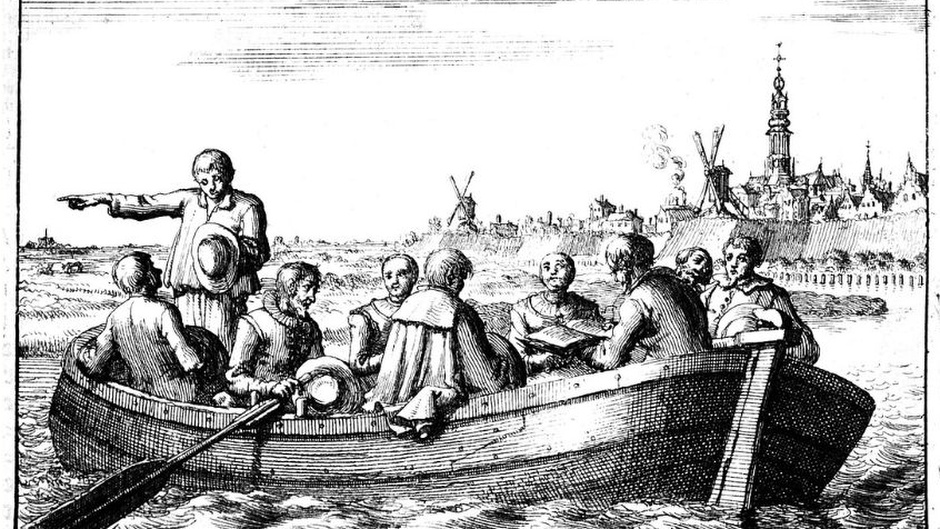
As citizens of the kingdom of God, we Anabaptists do not make good nationalists in any nation on earth. Historically, we have not fared well when we have become drawn into nationalistic thought and actions.
This content is part of the article The Christian and Nationalism, which was originally published by Anabaptist ViewPoint.